


Screw Jacks
Our robust screw jacks precisely convert rotary motion into linear lifting motion and are ideally suited for demanding positioning applications. These mechanical components are ideal for industrial presses, conveyor systems, and stage lifting systems for safely raising and lowering heavy loads.
- Lifting capacity up to 100 kN (up to 1,000 kN on request)
- Rotating or stationary spindle
- Various configurations available

Prices come with your quote – response within 48h (Mon – Fri)
Volume discounts & freight cost coverage for annual orders on request.
Technical Overview
| Lifting Force | up to 100 kN (up to 1,000 kN on request) |
| Gear Ratios | 4:1 to 36:1 |
| Max. Input Torque | non-rotating screw 60.20 Nm (based on 1,800 rpm) · rotating screw 60.19 Nm (based on 1,500 rpm) |
| Spindle Types | rotating / stationary |
| Housing | Die-cast aluminium / Steel |
| Spindle Material | Steel (stainless steel optional) |
These are basic values. Detailed technical information and diagrams can be found in the PDF catalogue.
Interactive Configurator
TSE Screw Jack Configurator
Six questions — lifting force, spindle version, stroke, speed and options. A pre-selection for your quote request, not an engineering calculation.
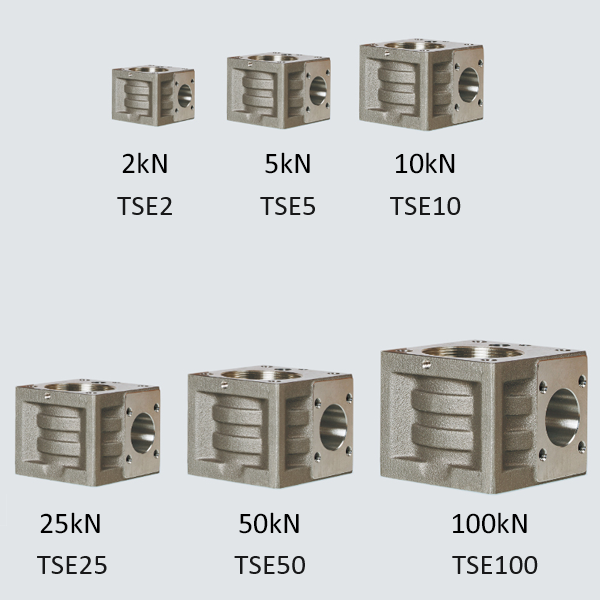
Lifting Force
Select the required lifting force for your application.
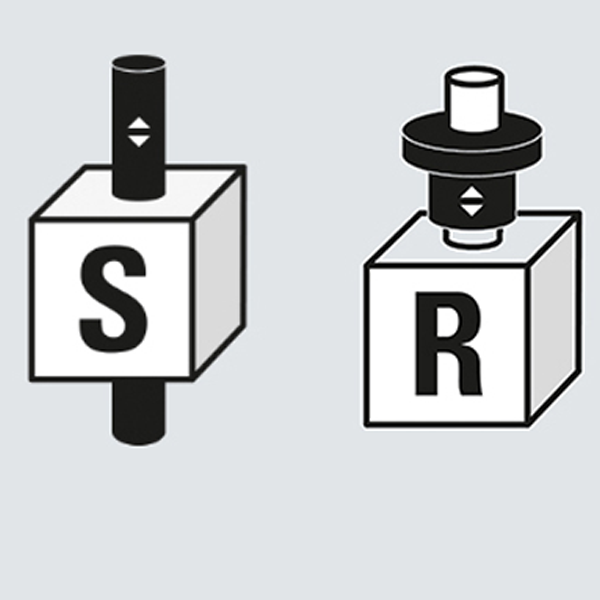
Compatible Products
These products can be optimally combined with this product.


Frequently Asked Questions
A screw jack turns a rotary motion into a lifting motion – much like a car jack with a crank. A motor or a hand crank turns the input shaft. Inside the housing is a worm gear: the worm on the input shaft drives a worm wheel, reducing the speed and increasing the torque. The worm wheel moves a threaded spindle. In the stationary-spindle version, the worm wheel has an internal thread and pushes the spindle out of the housing or pulls it back – the spindle lifts the load. In the rotating-spindle version, the spindle turns with the worm wheel and a nut on the spindle travels up and down with the load. How fast the load moves depends on the input speed, the gear ratio and the spindle lead.
Our screw jacks are designed for lifting forces exceeding 100 kN. The exact lifting force depends on the frame size, the lead of the spindle, and the chosen spindle type (trapezoidal or ball screw). Reinforced versions are available for exceptionally high loads. Contact us for a project-specific engineering consultation.
The lifting speed is determined by the spindle lead and the input speed. Trapezoidal screw spindles achieve moderate lifting speeds with high positioning accuracy, while ball screws allow higher travel speeds with reduced wear. The optimal configuration depends on your requirements for speed and load capacity.
Yes, our screw jacks can be combined into multi-axis systems via mechanical connecting shafts, bevel gearboxes, or electronic synchronization. This enables uniform lifting and lowering motion at multiple points, as required for lifting platforms, presses, or stage systems.
Trapezoidal screw spindles offer the advantage of self-locking – the load remains in position without an additional brake. They are also more cost-effective and more robust against contamination. Ball screws achieve significantly higher efficiency (approx. 90% vs. 30–50% for trapezoidal thread), higher lifting speeds, and a longer service life, but generally require a holding brake.
For use in demanding environments, we offer screw jacks with various protective measures, including bellows, telescopic covers, and special seals. In addition, corrosion-resistant versions for use in wet or chemically aggressive environments are available.
Self-locking depends on the spindle type used. Screw jacks with trapezoidal screw spindles are generally self-locking and safely hold the load in position without an additional brake. Versions with ball screws, on the other hand, are not self-locking and require an external holding brake, but offer significantly higher efficiency.
We offer screw jacks in both rotating and stationary spindle configurations. In the rotating version, the spindle rotates and the lifting nut travels linearly. In the stationary version, the spindle is fixed and the nut rotates, enabling a more compact design. Both versions are documented in detail in our catalogs.
Related guides & tools
Designing Spindle Jacks Step by Step
Step-by-step guide to designing spindle jack gearboxes.
GuideLinear Actuator vs. Screw Jack: Choosing the Right Drive
Decision guide between electric linear actuators and screw jacks.
ToolSpindle Jack Sizing: Speed & Motor Torque
Interactive calculator for lifting speed and motor torque for spindle jacks.
Thank you for your feedback.
Anonymous · without cookies