PMKC · A BRAND FROM HAMBURG

PMKC.
Magnetic couplings
from Hamburg

Contactless torque transmission without a shaft seal. Hermetically sealed, wear-free, adjustable torque.

PMKC Series: 5 sizes (PMKC-30 to PMKC-90), 0.5–20 Nm, up to 300 °C — compact, in stock in Hamburg.

Pumps/Chemicals Mixers/Pharmaceutical Vacuum Technology Food Maritime
PMKC Data Sheet Request a quote
Go directly to Why PMKC Product Range Technical Specifications Application Design FAQ
PMKC Magnetic Clutch — Permanent Magnet Slip Clutch from Technische Antriebselemente Hamburg
PMKC Quick Specs
5 sizes · 0.5–20 Nm · up to 300 °C
SmCo magnets · 1.4401 stainless steel
DIFFERENTIATION

Why PMKC?

PMKC offers features that are rarely found together on the market—our brand, proven over many years, is manufactured and designed in Hamburg.

PMKC — our brand from Hamburg

Short supply chains, direct contact, and full control over quality and availability. Design, manufacturing, and final inspection in Hamburg—with no middlemen.

Hermetic seal

Torque transmission through a non-magnetic partition—no shaft seal, no leakage path. Complete media separation between the drive and the driven side. Ideal for aggressive media, cleanrooms, and pressure vessels.

Wear-free slip clutch

In the event of an overload, the clutch slips without contact—causing no wear or damage. Automatic overload protection for downstream machine components. In normal operation: completely maintenance-free.

Adjustable torque

The transmissible torque can be adjusted during operation by simply adjusting the air gap. No component replacement is necessary—respond flexibly to changing process requirements.

High-temperature-resistant

SmCo magnets with a Curie temperature of 800 °C — PMKC can operate at temperatures up to +300 °C. Suitable for hot process gases, steam applications, and high-temperature pumps.

In-house design expertise

Magnetic coupling + DC/induction motor + gearbox—all from a single source—as a single-source supplier for the complete drive train. Reduces interface risks and procurement effort.

Seawater-resistant

Fully constructed from 1.4401 stainless steel — seawater-resistant as standard. Suitable for marine, offshore, and underwater applications.

SERIES

The PMKC Product Line

5 sizes (PMKC-30 to PMKC-90) for 0.5–20 Nm — compact, ultrasonically welded, up to 300 °C, in stock in Hamburg.

COMPACT MAIN LINE

PMKC

5 sizes: PMKC-30 to PMKC-90 · in stock in Hamburg
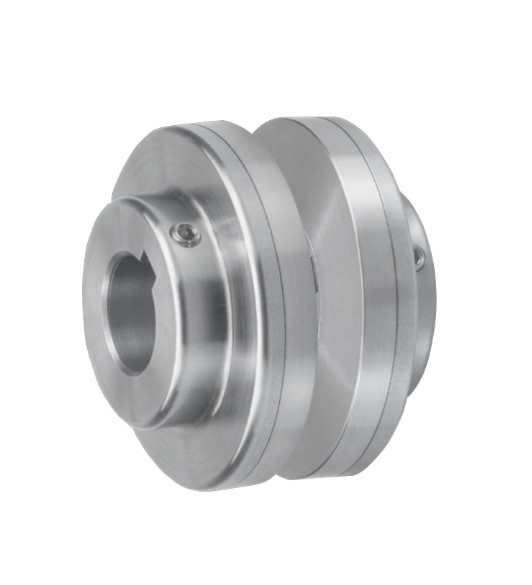
PMKC Magnetic Clutch — Permanent Magnet Slip Clutch from Technische Antriebselemente Hamburg
Specifications
Torque0.5–20 Nm (with a 1 mm gap)
Outer diameter30–90 mm
Total length15–25 mm (low-profile design)
Maximum operating temperatureup to 300 °C
Curie temperature (SmCo)800 °C
HousingStainless steel 1.4401
lidUltrasonically welded (leak-tight as shipped)
Mounting2 grub screws, offset by 90°
Special Features
  • Low-profile, space-saving design (15–25 mm long)
  • Ultrasonically welded — leak-proof right from the factory, no adhesive
  • Operating temperature up to 300 °C thanks to SmCo magnets
  • Seawater-resistant 1.4401 stainless steel housing — Standard
  • Pre-drilled, grub screws (90° offset)
  • Slips through without contact in case of overload — wear-free
5 sizes — Rated torque at a 1 mm gap
PMKC-30
0,5 Nm
PMKC-45
2,2 Nm
PMKC-55
3,5 Nm
PMKC-70
8 Nm
PMKC-90
20 Nm
Complete specification tables Detailed technical specifications for all series
TECHNICAL SPECIFICATIONS

Complete specification tables

All 5 PMKC sizes at a glance.

PMKC Series — 5 sizes

Compact series. All torque values are based on a 1 mm air gap.

Item No. Outer diameter [mm] Overall length [mm] Pilot hole diameter [mm] Max. bore diameter [mm] Rated torque at 1 mm [Nm]
PMKC-30 30 15 5 8 (ohne Nut) 0,5
PMKC-45 45 15 5 10 (ohne Nut) 2,2
PMKC-55 55 17 6 14 (mit Nut) 3,5
PMKC-70 70 25 6 22 (mit Nut) 8
PMKC-90 90 25 11 (mit Nut) 35 (mit Nut) 20

* Housing: 1.4401 stainless steel | Lid: ultrasonically welded | Max. operating temperature: 300 °C

Magnetic couplings in use Industry Examples & Typical Applications
APPLICATIONS

Magnetic couplings in use

Anywhere where leak-free operation, overload protection, or media separation are critical.

Magnetic drive pumps (chemical industry)

Drive for pumps handling aggressive media (acids, alkalis, solvents) — contactless torque transmission through a tank wall, without a shaft seal and without a leakage path. Baffle made of 1.4571 or Hastelloy, depending on the medium. Typical: Designed for 1.5–2× the rated torque as a safety margin.

Discuss requirements →

Bioreactors & Agitators (Pharma/Biotech)

Hygienic design for CIP/SIP-cleaned bioreactors and stirred tanks. A magnetic coupling enables a sealed agitator drive through the reactor wall without shaft seals. Baffle made of 1.4435 or 1.4404.

Discuss requirements →

Vacuum & Semiconductor Technology

Rotary union without a shaft seal ring — no outgassing issues caused by sealing materials. Low-outgassing SmCo magnets are recommended for cleanrooms — PMKC specification available upon request. Typically used in airlocks, chambers, and substrate handling.

Discuss requirements →

Food & Pharmaceuticals — Hygiene Applications

Stainless steel housing (1.4401), low-dead-space design, surfaces designed for easy cleaning. No lubricant ingress, no shaft seal friction. Suitable for dosing systems, filling, and sterile processes.

Discuss requirements →

Maritime & Offshore Applications

Seawater-resistant PMKC model with a fully stainless steel 1.4401 housing (standard). For pumps in saltwater environments, marine diesel generator peripherals, and offshore platforms.

Discuss requirements →

Measurement & Testing Technology

Torque limiters on test benches with a defined trigger threshold. Display of readings on a circular scale in a different medium (e.g., a pointer in a pressure-tight housing). The air gap precisely sets the torque threshold.

Discuss requirements →

Underwater robotic arms (ROV/AUV)

Power and torque transmission in underwater robotic arms without mechanical shaft seals. Seawater-resistant housing 1.4401 — no leakage into the drive or joint enclosure. Used in ROV manipulators, maritime exploration, and underwater inspection systems.

Discuss requirements →
How does a magnetic clutch work? Operating Principle, System Architecture & Animations (Normal Operation + Overload)
SYSTEM ARCHITECTURE

How does a PMKC magnetic coupling work?

Two coupling halves equipped with rare-earth magnets face each other end-to-end. Torque is transmitted contactlessly through the air gap—optionally via a baffle plate. No shaft seal, no leakage path.

PMKC Magnetic Coupling System Design — Longitudinal Section: Motor on the left, drive shaft, coupling half 1 (magnetic disc, drive side), axial air gap with a flat boundary wall made of non-magnetic material, coupling half 2 (magnetic disc, output side), output shaft, load (pump) on the right. Longitudinal section of an axial permanent magnet slip clutch (PMKC): Motor on the left, drive shaft extending horizontally to the right. Coupling half 1 — a vertical magnetic disc (blue) with rare-earth magnets (N/S blocks) on the right end face. In the center: axial air gap with adjustable clearance; within it, a thin, flat, vertical stainless steel partition (dark gray) that hermetically separates the drive side from the medium side. Coupling half 2 — second magnetic disc (blue) with magnets on the left end face, opposite half 1. On the right, the output shaft and the load (pump/agitator). The output side can be immersed in the medium within a closed vessel. Drive side (dry) Media side / Inside of the container Engine Drive Drive shaft N S N S Clutch half 1 (Drive side) adjustable air gap Retaining wall (non-magnetic, stainless steel) S N S N Clutch half 2 (Output side, inside the housing) Output shaft Pump / Agitator working medium Contactless torque transmission — via the air gap at the front In case of overload: non-contact slippage → wear-free safety clutch Longitudinal section — axial permanent magnet slip clutch (schematic) Clutch halves = Magnetic discs with rare-earth magnets on the end face Retaining wall = flat non-magnetic partition (stainless steel) — hermetic zone boundary

Two opposite Clutch halves (Magnetic discs with rare-earth magnets on the end face) transmit torque contactless via an axial air gap — optionally through a Retaining wall made of non-magnetic material, which hermetically seals off the drive side from the fluid side. The Air gap distance is adjustable and determines the transmissible torque. In the event of an overload, the coupling slips without causing wear—no shaft seal, no leakage path, no mechanical contact.

Animation: How a magnetic coupling works

Side view (cross-section): two magnetic discs with opposing N/S poles at the air gap — a comparison of normal operation (synchronous) and overload (slippage).

Normal operation Load ≤ rated torque → output follows synchronously
Normal operation of the PMKC — Side view: The motor drives the drive pulley, and the driven pulley follows in sync via the magnetic coupling at the air gap. Side view of two magnetic discs standing on edge, separated by a narrow air gap with a boundary wall. Each disk displays alternating N/S pole bands; each N-pole faces the S-pole of the opposite disk. Both pole patterns move upward in sync. Pulsating field lines in the gap indicate the contactless magnetic coupling. Drive pulley Output pulley M Engine Pump / Load Retaining wall (non-magnetic) Torque (non-contact) N S N S N S N S N S N S N S N S N S

Normal operation: Der Engine (left) drives the drive pulley. Each one is separated by the air gap North Pole dem S-Pol opposite the output pulley—the pulleys are magnetically locked and run in synchrony without physical contact (the pole bands move upward in unison). Torque is transmitted without mechanical contact, shaft seals, or leakage paths to the Load (right).

Overload Load > Rated torque → Output shaft slips without contact (no wear)
PMKC overload — Side view: The drive pulley runs smoothly, while the driven pulley slips erratically (slippage without wear). Side view: The left drive pulley moves upward evenly. The right output pulley (orange) slips jerkily and more slowly—its pole bands skip and are no longer aligned. A warning symbol indicates that the clutch point has been exceeded. Contactless, therefore no wear. Drive pulley Output pulley (slips through) M Engine Load blocked Clutch overrun N S N S N S N S N S N S N S N S N S No contact · No wear · Automatic protection

Overload: If the load torque exceeds the rated torque, the magnetic poles can no longer drive the opposite disc—they "jump over". The driven pulley slips jerkily and significantly slower than the drive pulley (its pole bands jerk along instead of moving in sync). Since there is no mechanical contact, this results in no wear and tear. As soon as the load decreases, the two discs automatically synchronize again.

What does this mean for you?

  • Hermetically sealed — no shaft seals as wear parts: scheduled maintenance instead of unscheduled downtime due to leaks and emergency purchases.
  • Fewer spare part SKUs: Shaft seals, lip seals, and packing glands are no longer consumables—simplifying inventory management.
  • Predictable operating costs: no fluid loss due to leaks, no disposal costs for leaked working fluids.
Design & Sizing Interactive Tool: Find the Right PMKC Size
DESIGN TOOL

Which PMKC size is right for you?

Enter the required torque, select the operating mode—the tool recommends the appropriate PMKC size and generates a pre-filled request. In less than a minute.

Your application

Enter the torque and operating mode.

Torque requirement
Nm

The maximum operating torque of the application (without a safety factor).

Industry-standard safety factors: 1.5× rated torque (standard) — 2.0× (shock loads, high temperatures, critical processes).

Design result

Enter the required torque on the left—the appropriate PMKC size will appear immediately.

Note: This tool is intended solely for initial guidance and does not replace a binding design assessment by qualified specialists. Air gap, temperature, speed, and combined loads affect the actual transmissible torque and must be reviewed during the design consultation with TEA. Technische Antriebselemente GmbH assumes no liability for damages resulting from the use of the calculation results.

PMKC Series — Rated Torques at a Glance

All values are based on a 1 mm air gap.

SIZE Outer diameter Rated torque (1 mm gap) Total length
PMKC-30 30 mm 0,5 Nm 15 mm
PMKC-45 45 mm 2,2 Nm 15 mm
PMKC-55 55 mm 3,5 Nm 17 mm
PMKC-70 70 mm 8 Nm 25 mm
PMKC-90 90 mm 20 Nm 25 mm

Housing: 1.4401 stainless steel · Ultrasonically welded lid · Up to 300 °C.

RESOURCES

Downloads & Technical Documents

PMKC data sheet and other documents. CAD data available upon request.

PMKC Magnetic Clutches Data Sheet
PDF · 2 pages · PMKC-30 to PMKC-90
CAD Data for Magnetic Couplings
CAD model in progress — available upon request
Shop: Order magnetic couplings online ↗
PMKC-30 to PMKC-90 — 7 in stock · Free shipping on orders over €150

Frequently Asked Questions About PMKC Magnetic Clutches

+49 [40] 5388921-11 sales@tea-hamburg.de